
Engineers Lose Days, Sometimes Weeks, Just Reproducing a bug seen by a customer. Here's Why.
Before debugging even starts. After 18 years in embedded systems, the real time sink isn't debugging, it's everything that happens before it.

Before debugging even starts.
By Wissem Golli, Founder & CEO of Sagy
After 18 years working on embedded software systems, one thing kept repeating itself across almost every team I joined:
Some customer bugs take days — sometimes entire weeks — just to reproduce.
Not to fix.
Just to reproduce.
And most of that time is spent doing repetitive operational work that engineers hate doing.
The Reality of Debugging Embedded Systems
A customer reports an issue on a specific device:
- a WiFi router randomly drops the 5GHz connection
- a gateway reboots under heavy traffic
- a firmware update breaks device association
- mesh synchronization fails after a topology change
- a device freezes only after running for several hours
The issue is real.
But before anyone can debug the root cause, someone has to reproduce it first.
That's where the real time sink begins.
What Actually Happens Before Debugging Starts
An engineer gets assigned the ticket.
Then the operational investigation begins.
They have to:
- identify the exact firmware version running on the customer device
- recover the matching build environment
- flash the correct firmware image
- rebuild the customer setup
- configure the network correctly
- connect through serial or SSH
- reproduce the topology and traffic conditions
- inspect logs and crash traces
- read the full Jira ticket history
- search Slack discussions for similar issues
- review commits touching the subsystem
- ask senior engineers for historical context
Only then can they attempt reproducing the issue.
Sometimes it reproduces immediately.
Most of the time, it doesn't.
So they retry:
- different firmware builds
- different timing conditions
- different WiFi configurations
- different traffic loads
- different hardware states
Again.
And again.
And again.
Meanwhile, hours turn into days.
Sometimes weeks.
The Painful Part Is Not the Debugging Itself
The painful part is the repetitive operational work surrounding debugging.
And honestly, humans are not good at this type of repetitive investigation.
After the fifth failed reproduction attempt:
- focus drops
- logs get skimmed
- context gets forgotten
- old Slack threads get missed
- edge cases stop being tested carefully
Not because engineers are bad.
Because this work is mentally exhausting.
Especially when most of it is repetitive setup and investigation instead of actual engineering reasoning.
What if an AI Agent Handled the Investigation Workflow?
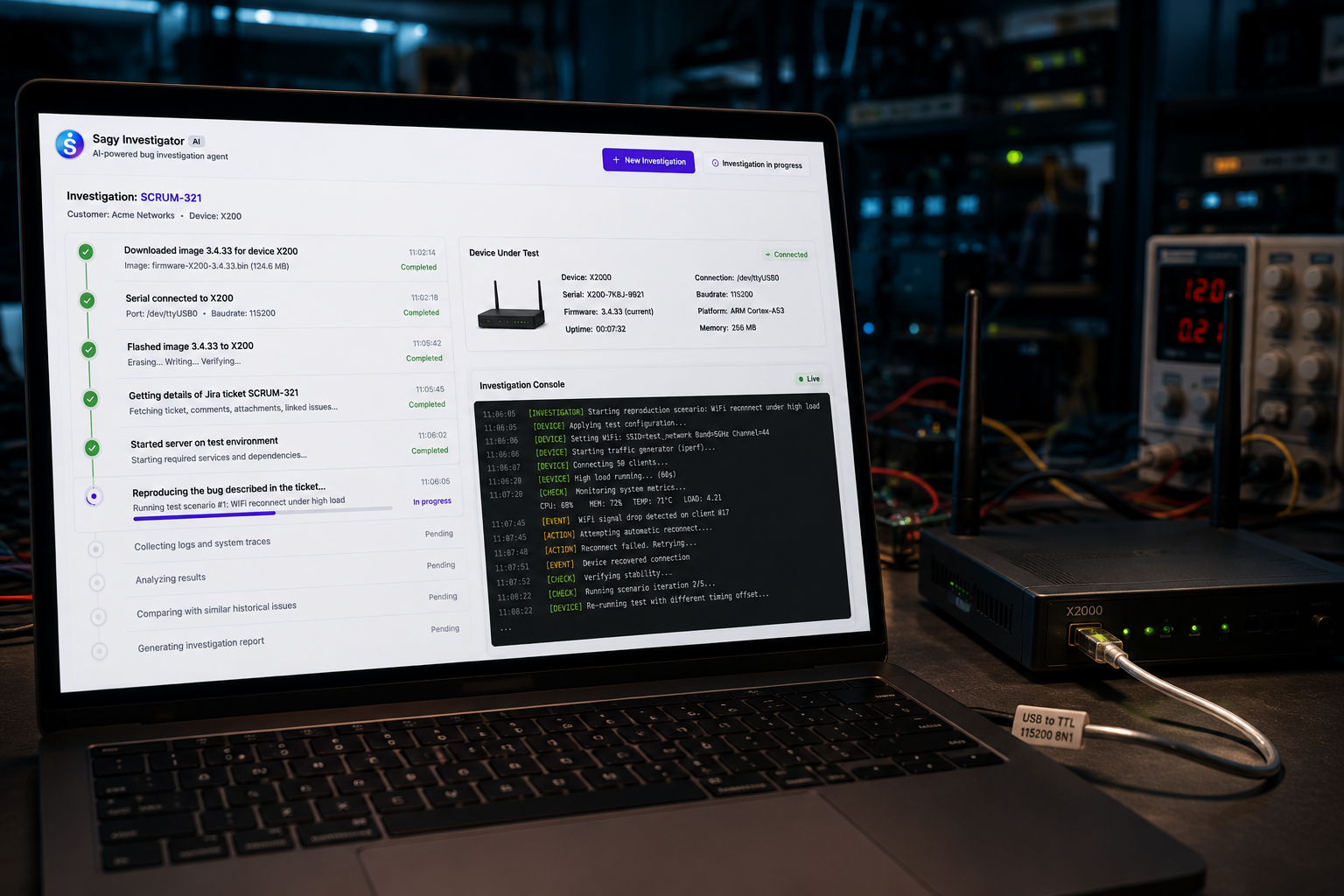
This is the direction we're building toward with Sagy.
A customer issue arrives.
The engineer launches an investigation agent and provides the ticket number.
The agent:
- → reads the Jira ticket
- → analyzes logs and crash traces
- → searches related Slack discussions
- → retrieves similar historical incidents
- → checks recent commits
- → identifies the exact firmware version
- → prepares the environment
- → flashes the device automatically
- → connects through serial or SSH
- → executes the reproduction workflow
- → retries known edge-case scenarios
- → captures logs automatically
- → documents everything it observes
And unlike humans, the agent doesn't lose patience on attempt number seven.
It keeps investigating consistently.
When the issue reproduces, the engineer receives:
- the reproduction steps
- captured logs
- related historical context
- likely regression areas
- similar past incidents
- an initial investigation summary
Only then does actual debugging start.
The Engineer Stays in Control
The goal is not to replace embedded software engineers.
The goal is to remove the repetitive operational work that slows them down.
The engineer still handles:
- ✓ root-cause analysis
- ✓ low-level debugging
- ✓ architecture decisions
- ✓ firmware fixes
- ✓ final validation
But instead of losing days rebuilding environments and recovering context, they can focus directly on solving the problem.
Why Embedded Software Teams Feel This Pain More Than Anyone
Embedded debugging is uniquely painful because:
- hardware environments matter
- firmware versions matter
- timing matters
- topology matters
- reproductions are unstable
- knowledge is fragmented across tools and people
A lot of critical operational knowledge lives inside senior engineers:
- how to reproduce specific failures
- which commands to run
- which logs actually matter
- which hardware states trigger edge cases
- which workaround was discovered six months ago
And every time that knowledge is missing, engineering velocity slows down.
Where We Believe This Goes
AI agents will not replace embedded engineers.
But they will increasingly handle:
The companies that operationalize this first will move dramatically faster than the ones still relying entirely on tribal knowledge and manual investigation.
That's the direction we're building with Sagy.